
A shaved or balding head in the full June sun can lead to a burn that sets in within half an hour. The skin on the scalp, thin and rarely accustomed to direct exposure, reddens quickly and heals poorly. Choosing a cap when you’re bald is not a matter of style: it’s primarily about concrete sun protection, with criteria very different from those of someone with thick hair.
UPF fabric and light color: what really blocks UV on a bare head
It’s often thought that a cap provides default protection. In practice, a fine, dark cotton allows a significant portion of UV rays to pass through while trapping heat under the cap. On a hairless head, this combination causes double discomfort: rapid overheating and insufficient protection.
UPF (Ultraviolet Protection Factor) certified fabrics change the game. Brands like Soway offer headgear that filters up to 99.9% of UV rays thanks to anti-UV treatments integrated into the fiber. A UPF 50+ fabric blocks nearly all radiation, whereas basic cotton can allow enough UV to cause sunburn with prolonged exposure.
In terms of color, light shades (beige, off-white, light gray) reflect light instead of absorbing it. Today, there are good guides for choosing a cap for bald men on Allure Mode, which detail these often overlooked technical aspects in supermarket aisles.

Ventilation and lining: avoiding the pressure cooker effect on the head
One point that catalogs rarely mention: a poorly ventilated cap on a bald head becomes a thermal trap. Without hair to absorb sweat, moisture stagnates directly between the skin and the fabric. The result is rapid irritation, sometimes heat bumps on the top of the head.
What makes a difference in ventilation
- Mesh panels at the back or sides allow for real air circulation, not just cosmetic. They can be found on so-called “trucker” models or on some running caps.
- Metal eyelets on the cap help, but not as much as a true ventilated panel. They are suitable for moderate exposure, not for an entire day outdoors.
- A sweat-absorbing band lining (like sponge or microfiber) against the forehead and scalp limits sweat drips and reduces friction that irritates bare skin.
- Models without a rigid inner lining avoid visible pressure marks on a shaved head after a few hours of wear.
Feedback varies on this point, but generally speaking, a structured model with a slightly elevated crown (not pressed against the head) offers better thermal comfort than a soft cap that clings to the skin.
Coverage of the nape and ears: the areas that a classic cap forgets
The front visor protects the forehead and nose. The top of the head is covered by the crown. There remains a blind spot that many discover afterward: the nape and tops of the ears burn just as much as the scalp on a bald person.
A short-visor cap does not cover the back or sides. For exposure of more than an hour (hiking, gardening, construction), two options deserve consideration.
Saharan cap with neck flap
This model includes a removable flap at the back, often made of UPF fabric. It is mainly seen among fishermen and hikers, but it is now available in more urban cuts. The neck flap transforms an ordinary cap into nearly complete protection.
Wide-brimmed cap or short-brimmed bucket hat
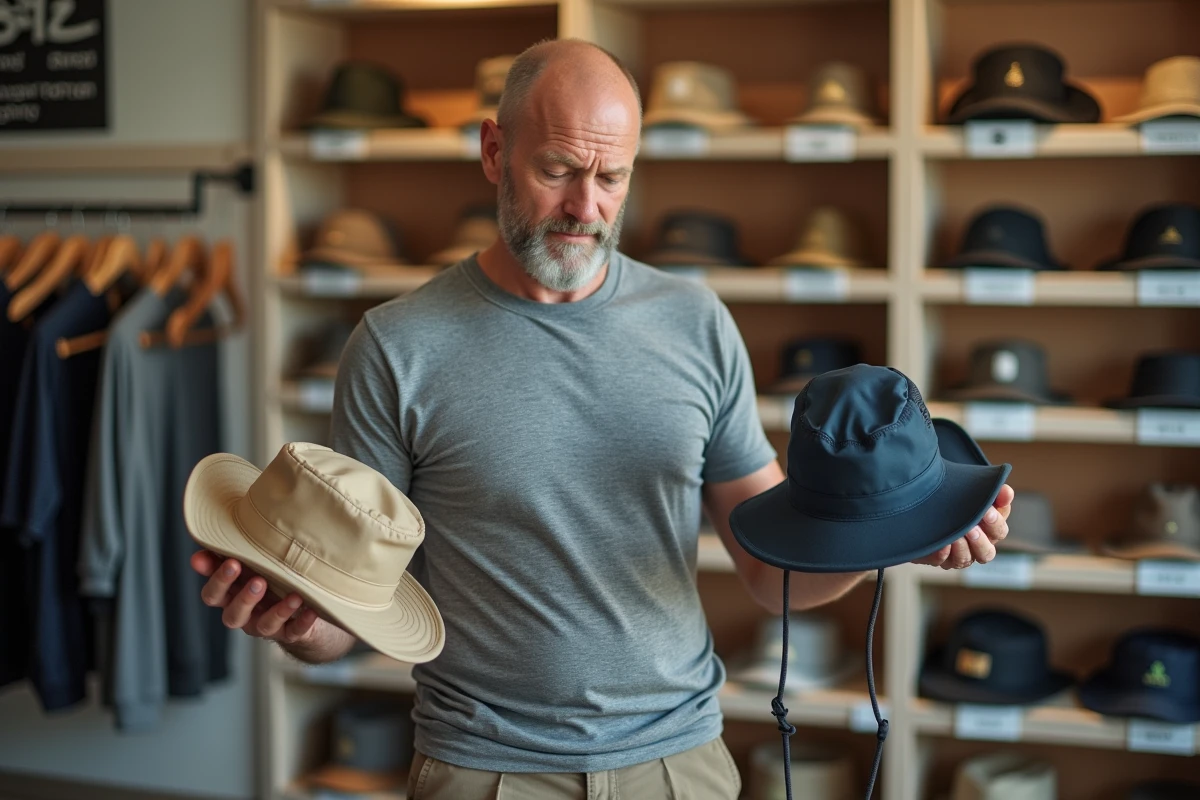
Some caps offer a longer, slightly curved visor on the sides. The short-brimmed bucket hat naturally covers the ears and nape without the bulk of a wide-brimmed hat. For a bald head, it’s an effective compromise between coverage and discretion.
Sunscreen under the cap: a supplement that many neglect
Health authorities regularly remind us: a cap alone is not enough to prevent skin cancers of the scalp. Partially covered areas (temples, ears, nape) remain exposed, and even under the crown, a non-UPF certified fabric allows UV to filter through.
Applying sunscreen on the scalp before putting on the cap is not paranoia. Carcinomas and melanomas of the scalp particularly affect balding men who work or play sports outdoors. The cream acts as a safety net under the fabric, especially at seams and panel junctions where textile protection weakens.
For the nape and ears, sunscreen becomes essential if the cap does not have a back flap. A high SPF rating, applied every two hours, complements what the fabric does not cover.
Adjustable size and fit: the detail that changes everything on a smooth head
A shaved head is smooth. A cap that fits perfectly on thick hair can slip, turn, or blow off at the slightest gust of wind when there is no longer any hair friction to hold it in place.
- Velcro or sliding buckle closures at the back allow for precise adjustment, millimeter by millimeter.
- A silicone or textured grip inner band prevents the cap from turning on a sweaty head.
- Avoid one-size fits all without adjustment: on a bald head, they are either too tight (visible pressure marks) or too loose (the cap tilts forward).
The last reflex before buying: try the cap on a bare head, not over hair. The actual head circumference of a shaved head often differs from that measured with hair, and a poor fit leads to discomfort within the first hour of wear.