The lake of Aiguebelette, classified as a Regional Nature Reserve since March 6, 2015, concentrates a bird diversity on its shores and reed beds that the regulations actively protect. Which species actually inhabit this Savoyard body of water, and what factors condition their presence according to the seasons? This is what observation data and access constraints to the site allow us to measure.
Access Regulations for Lake Aiguebelette and Observation Areas
Most tourist content presents the lake as a place for free walks, without detailing the restrictions that frame the approach to sensitive habitats. The reality on the ground is more constrained.
Since the creation of the Regional Nature Reserve, motorized navigation has been gradually limited, and launching points concentrated on a few developed beaches. The reed beds and bird islands are subject to minimum distances to be respected, which considerably reduces the observation points accessible by boat.
For those wishing to discover the birds of Lake Aiguebelette, the direct consequence is clear: the best listening posts are accessible on foot or from the shore. The areas prohibited to navigation are not an obstacle for the patient ornithologist, but they require advance identification of pedestrian access to the reed bed sectors and the banks of the tributary streams.
| Zone | Authorized Access | Ornithological Interest |
|---|---|---|
| North and South Reed Beds | On foot only, marked trails | Nesting (grebes, herons, reed warblers) |
| Central Islands | Navigation prohibited nearby | Resting and feeding of diving ducks |
| Developed Beaches | Free (outside swimming season: increased calm) | Shorebirds during migratory stopovers, wagtails |
| Tributary Streams | Hiking trails | Dipper, kingfisher |
Bird Species of Lake Aiguebelette: What the Surveys Show
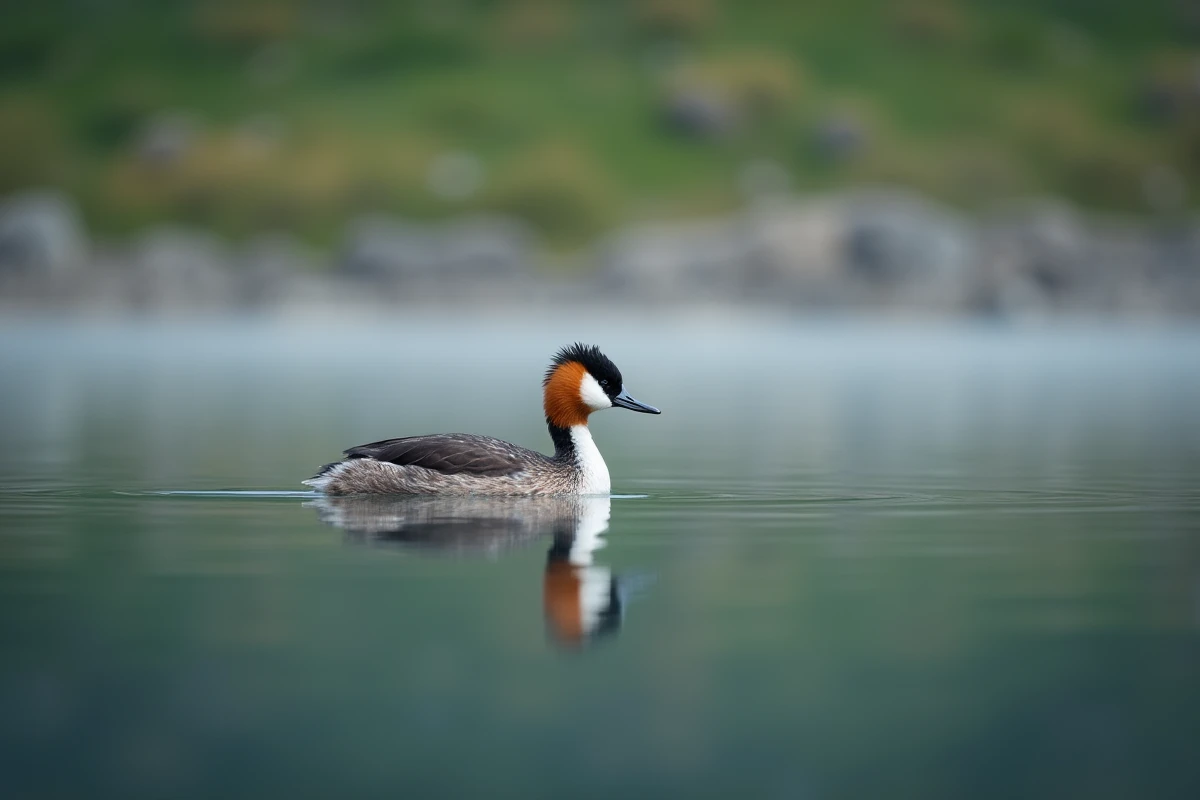
The Auvergne-Rhône-Alpes biodiversity atlas records regular observations in the municipality of Aiguebelette-le-Lac. Among the best-documented species, the great crested grebe (Podiceps cristatus) totals 69 observations, the latest dating from 2023.
The great crested grebe is not the only aquatic species present. The reserve reports a typical suite of mid-altitude lakes in France: herons, coots, mallards, and several species of passerines associated with wet environments.
Nesting Birds and Seasonal Visitors
The distinction between resident breeders and transient visitors conditions what can be expected to be observed according to the period:
- Great crested grebes and coots occupy the lake from spring to autumn, with courtship displays visible as early as March on the calm morning waters.
- Grey herons frequent the shores year-round, but their fishing activity is easier to observe during colder hours, when human activity decreases.
- During migration periods (autumn and late winter), shorebirds and diving ducks in transit stop at the lake, taking advantage of the freshwater and areas less disturbed by navigation.
The presence of mature trees on the shores and in nearby woodlands adds a second layer of observation: woodpeckers, tits, nuthatches, and forest raptors regularly soar over the area.
Disturbance and Sports Practices Around Lake Aiguebelette
Trail, running, and mountain biking circuits around the lake have multiplied in recent years, highlighted by platforms like Decathlon Outdoor, Komoot, or Cirkwi. These routes often run along the shores and tributary streams, precisely where the wildlife is most sensitive.
The repeated passage of runners or cyclists near nesting areas causes cumulative disturbance that natural reserve managers in France are increasingly documenting. The occasional noise of a walker differs from the continuous flow of athletes on a shared path.
Adapting Schedules and Routes
For a productive birdwatching outing, two parameters make a difference:
- Favor early morning slots (before 8 a.m.) or late in the day, when sports activities and beach attendance are at their lowest.
- Choose trails away from popular trail routes, aiming for secondary access points to the reed beds rather than the most frequented marked loops.
- During the summer season, tourist pressure on the beaches pushes some species towards the northern sectors of the lake, which are less developed and quieter.

Birdwatching at Lake Aiguebelette: The Question of Equipment
Lake Aiguebelette is well-suited for observation from the shore, but the distances imposed by regulations make a pair of binoculars with 8x or 10x magnification almost essential. A spotting scope mounted on a tripod allows for detailed observation of behaviors on the central islands, otherwise inaccessible.
A field notebook and a sound identification app complement the equipment usefully. The song of reed warblers in the reeds or the call of the kingfisher in low flight is often detected by ear before locating the bird visually.
The protected nature of the site and the access constraints to sensitive areas make Lake Aiguebelette an observation ground where patience and discretion matter more than proximity. The species present reward those who respect the distances and adapt their visit to the rhythms of the lake rather than those of summer tourism.